
Hermetic Seal Testing for Semiconductors
Fine Leak & Gross Leak Testing Services
Hermetic seal testing allows hermetically sealed components to be qualified prior to operation for confident implementation in high reliability industries such as Aerospace, Defence and Medical where they must last decades. A defective sealing process can cause small leaks leading to ingress of moisture and gas which either causes deterioration over time or immediate device failure.
The hermeticity test is composed of two stages; a Fine and Gross leak test where the Fine leak identifies micro leaks and Gross leak test which identifies larger seal defects in the device or package under test.
Fine Leak Test
Fine leak detection is performed first as the liquids used in gross leak detection can clog any cavities/voids leading to false pass results.
Fine leak testing is performed by using helium as a tracer gas which is forced into any potential component cavities via pressure. A mass spectrometer then probes the outside of the component in order to detect any helium leakage and if detected, calculates a leak rate in atm cm3/s.
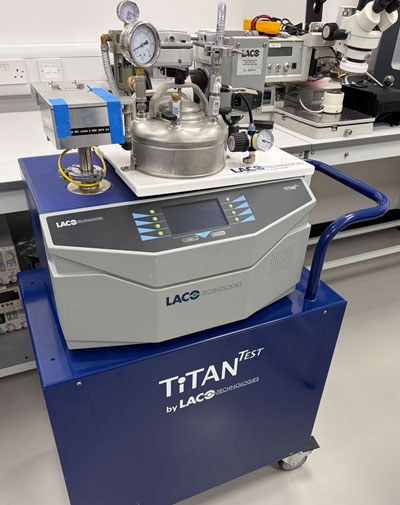
Titan Helium Mass Spectrometer & Pressurised Chamber (Fine Leak Detector & Helium Bomb)
How Do We Perform Fine Leak Testing?
Helium’s small molecular structure makes it a sensible choice for use as a tracer gas, its small size allows it to pass through microscopic defects in the seal that other gases can’t; additionally the low concentration of Helium in the natural atmosphere allows for highly accurate leak rate measurements.
At Reltronix we use a purpose built fine leak test system which is comprised of a vacuum pump, pressure bombing chamber and a mass spectrometer leak detector.
The hermetic components are loaded into an evacuated bombing chamber which is then filled with Helium and pressurised. The pressure forces Helium into any microscopic cracks/defects in the seal, the bombing time is dependent on variables such as expected leak size, package cavity volume and pressure level.
After bombing, the packages are removed and left to dwell allowing exterior helium to dissipate prior to leak detection to avoid false failures. Next they are placed into a test chamber with a connected leak detector which measures if Helium is leaking out the part and reports any leak rate in atm cm3/sec. Leak rates can be measured down to <5 x 10 -12 atm cm3/sec allowing us to exceed the seal test specifications of MIL-STD and also meet customer specific requirements.
Gross Leak Test
Gross Leak test exists to identify leaks that are too large to be detected by the helium Fine Leak Test. This is because after the bombing stage helium escapes large defects/voids at a leak rate beyond the measurable resolution of the mass spectrometer.
The right gross leak test condition must be determined by evaluating the cavity dimensions of the package to be tested and with consideration to equipment capability. In almost all cases gross leak testing should take place after fine leak testing. The gross leak test conditions should also take into account the test criteria of any preceding fine leak setup.
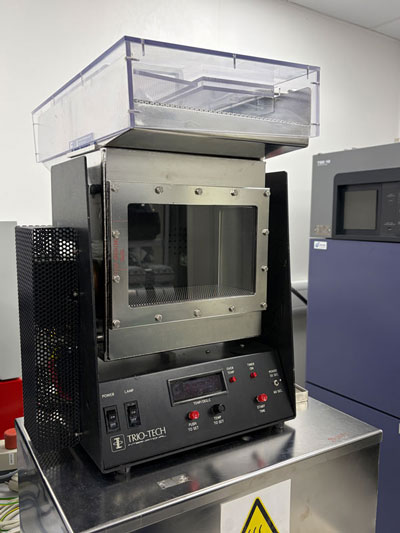
Trio-Tech Gross Leak Bubble Inspection Station (Gross Leak Bubble Tester)
How Do We Perform Gross Leak Testing?
For the majority of gross leak testing we perform, the packaged components are submerged in fluorocarbon indicator fluid at 125°C which causes the air inside the package to heat up, expand and to be forced out of any cavity or void in the form of bubbles. Under magnification an operator visually inspects the packages to check for bubble streams.
It’s also possible to follow an alternative process as defined in MIL-STD-883-1014 Test Condition C1. Here the components are placed in a evacuated bombing chamber, immersed in a detector fluid and pressure is applied. The components are then removed and prepped to be submerged in fluorocarbon indicator fluid at 125°C. Since the boiling point of the detector fluid is lower than the boiling point of the indicator fluid any leaks present visually in the form of indicator fluid vapour bubbles.
Gross leak testing can assist failure analysis and help troubleshoot hermetic seal process issues by visually highlighting the site of the leak.
These tests accompany other mechanical tests (die shear, wire bond pull, ball shear) that are offered here at Reltronix allowing for comprehensive device screening.
Military Standard Hermeticity Testing (MIL-STD) and Custom Specifications
Our testing capabilities across standard military configurations and custom component requirements:
Fine Leak
| Standard | Test Condition(s) | Test Scope |
| MIL-STD-883 Method 1014 | A1 and A2 | Fine leak testing methods for microelectronics. |
| MIL-STD-750 Method 1071 | H1 and H2 | Hermetic seal test methods for discrete semiconductor devices. |
| MIL-STD-202 Method 112 | G | Military gross leak test and fine leak test conditions for electronic and electrical component parts. |
Customer specific specifications – detection down to leak rates of < 5 x 10-12 atm cm3/sec
Gross Leak
| Standard | Test Condition(s) | Test Scope |
| MIL-STD-883 Method 1014 | C1 | Perfluorocarbon Liquid Gross Leak Test (Bubble Test) |
| MIL-STD-750 Method 1071 | C and D | Liquid Fluorocarbon Gross Leak Test & Fluorocarbon Weight-Gain Gross Leak Test. |
| MIL-STD-202 Method 112 | D and E | Fluorocarbon Gross Leak Bubble Testing. |
Sales & Support
Please contact us with your mechanical test requirements.
Need Prototype or Contract Assembly?
Beyond standalone mechanical testing, Reltronix provides cleanroom semiconductor packaging and assembly services. We integrate in-house qualification directly into our Die Attach Services, Wire Bonding Services, and Flip Chip Assembly workflows to streamline your product build and screening under one roof.